

Overview
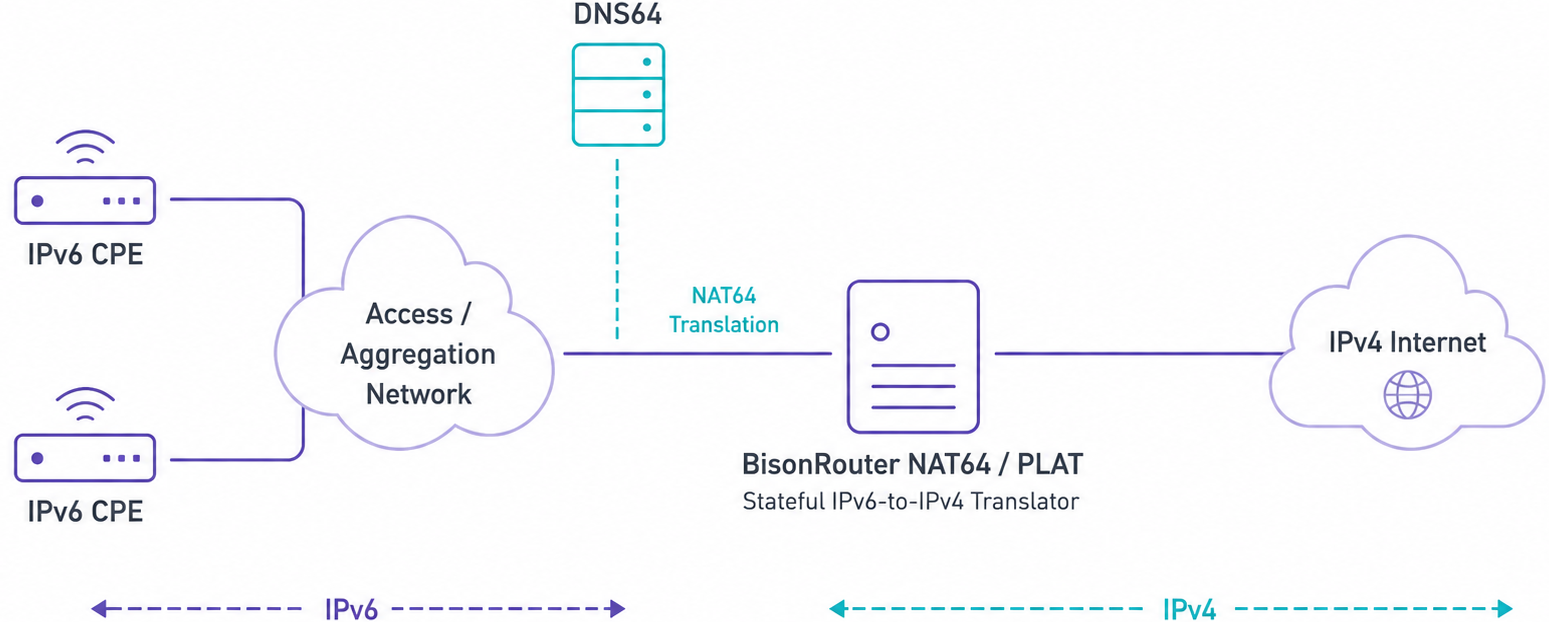
NAT64 helps IPv6-only subscribers reach services that are still available only over IPv4. It translates IPv6 traffic from the subscriber side into IPv4 traffic toward the destination service, and translates the return traffic back to IPv6.
This is especially useful for ISPs that want to move access networks and subscriber addressing toward IPv6 while still preserving practical connectivity to the IPv4 Internet. NAT64 reduces the need to assign public IPv4 addresses directly to subscribers and makes IPv6-only access networks easier to operate during the transition period.
Bison Router NAT64
Bison Router supports stateful NAT64 as part of its broadband edge and CGNAT feature set. It can translate IPv6 subscriber traffic to IPv4 services using configured IPv6 translation prefixes and IPv4 address pools.
The platform is designed for high-throughput deployments on commodity x86 servers. NAT64 can be used together with other Bison Router capabilities such as BNG, CGNAT, routing, subscriber control, and accounting.
How NAT64 Is Used
In a typical deployment, IPv6-only clients connect through the BNG or service edge. When those clients need to reach an IPv4 destination, the NAT64 function creates a translation state between the IPv6 client flow and an IPv4 address and port from the configured NAT pool.
DNS64 is often used together with NAT64. DNS64 synthesizes IPv6 records for IPv4-only destinations, allowing IPv6-only clients to initiate connections without application changes. NAT64 then handles the packet translation for TCP, UDP, and ICMP traffic.
Typical Use Cases
- IPv6-only broadband access, where subscribers receive IPv6 service but still need connectivity to IPv4-only content and applications.
- IPv4 address conservation, where public IPv4 capacity is limited and must be shared efficiently across many subscribers.
- Gradual IPv6 migration, where operators introduce IPv6-only access without cutting subscribers off from existing IPv4 services.
- Broadband edge consolidation, where NAT64 is deployed alongside BNG and CGNAT capabilities on the same software-based platform.
Performance Lab
Bison Router NAT64 has been tested in a dedicated performance lab that emulates IPv6 subscribers reaching IPv4 services through a stateful NAT64 translator.
- 24 Mpps total NAT64 translation rate in the steady-state test, roughly 192 Gbit/s with 1000-byte average packets.
- Around 2 million active NAT64 translation sessions.
- Around 131 thousand active IPv6 subscribers.
- Continuous session churn at approximately 27-30 thousand translations per second.
- Packet loss in the steady-state run measured at 0.0000385%.
The full test design, methodology, configuration, and results are available in the NAT64 performance lab report .
Standards-Based Translation
NAT64 relies on well-defined IPv6-to-IPv4 address and packet translation behavior. Bison Router is intended for standards-based deployments where NAT64 works with DNS64-capable resolvers and normal IPv6-only subscriber hosts without requiring changes to the client applications or the IPv4 servers being reached.