

Overview
Layer 2 Tunneling Protocol (L2TP) is commonly used in broadband networks to carry PPP subscriber sessions across an IP network. It separates the access side of the network from the point where PPP is finally terminated, giving operators more flexibility in how access, aggregation, wholesale handoff, and subscriber control are built.
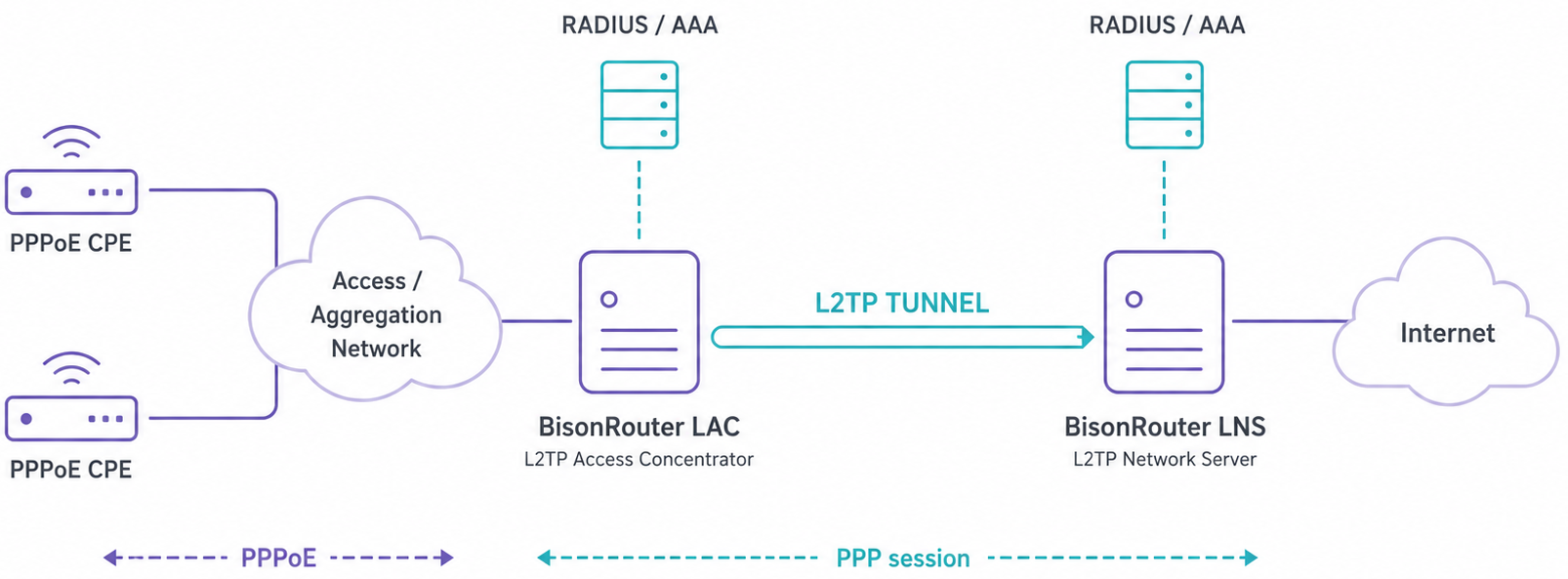
In a typical PPPoE deployment, a subscriber session reaches an access device or BNG that acts as an L2TP Access Concentrator (LAC). The LAC places the subscriber PPP session into an L2TP tunnel and forwards it to an L2TP Network Server (LNS). The LNS is the logical endpoint for the PPP session and applies subscriber authentication, addressing, routing, policy, and service control.
Bison Router LAC and LNS
Bison Router supports both L2TP operating modes used in broadband access networks: LAC and LNS.
In LAC mode, Bison Router can accept subscriber access sessions and forward PPP traffic through L2TP tunnels to one or more remote LNS systems. This is useful for wholesale access, third-party service handoff, and designs where PPP termination is intentionally placed deeper in the provider network.
In LNS mode, Bison Router can receive L2TP sessions from remote LACs and terminate the PPP subscriber sessions on the BNG. This allows the operator to centralize subscriber control while using existing access infrastructure or partner access networks.
Typical Use Cases
L2TP is often used when the access network and the subscriber service edge are operated separately, or when an operator wants to centralize PPP termination away from the physical access network.
- Wholesale broadband, where one provider owns the access network and another provider terminates and manages the subscriber session.
- Centralized PPP termination, where regional access networks tunnel sessions to a smaller number of service-edge locations.
- Migration from legacy access or BNG platforms to a modern software-based subscriber edge.
- Multi-vendor access environments where L2TP provides a standard handoff model between network elements.
RADIUS and Interoperability
Bison Router integrates L2TP subscriber access with RADIUS-based AAA. RADIUS can be used for subscriber authentication, authorization, accounting, and operational control in L2TP-based broadband deployments.
The implementation is designed for standards-based interoperability. Bison Router can work with other vendors' LAC or LNS equipment when those systems follow the relevant L2TP and PPP RFC behavior, including RFC 2661 for L2TPv2.